
Talking with Giuseppe Dante Sapienza
Happy Tuesday everyone! Glad to have your attention again for this new episode from Inside the Photo.
Thank you so much, once more, for dedicating some of your precious time to read my articles. I truly appreciate that.
Now, today’s guest is a very talented portrait photographer I initially met on Substack. Where I discovered he’s also a great writer. Here’s a bit more about Giuseppe.
I’m Giuseppe Dante Sapienza. Born in Italy, family moved to Australia when I was 2, and lived here my entire life. I am currently a professional portrait photographer. Now in my 50s, I have delved into many different creative mediums; from graphic designer, to struggling fine art artist, to feature film production designer, and finally to photography. Even though one of my very first jobs was in an old school minilab developing film, I only picked up photography as a primary craft later in my career. That said, I have now been a professional photographer for close to 20 years.
My focus is mainly on portrait and fashion work, with portraiture being my primary passion for the past few years. In all honesty, portrait and fashion photography wasn’t what I initially intended to pursue. However, I quickly developed a style that became recognisable as my own, and in a short time, I was approached for collaborations, paid shoots, and even workshops. Early on, I was constantly surprised when people told me they recognised one of my photos purely by its look, which reinforced that I was on the right track, when it came to making this my career.
Finding one’s own style is incredibly important for a photographer. It’s the single key thing that will set you apart from 100 other photographers in your city, who all shoot the same subjects. Finding that style is also one of the toughest challenges for a beginning photographer. All I can suggest is to keep your work as close to who you are as possible, make it your own, and always trust your instincts. It’s your eye and your unique point of view on the world that shape the images you capture and the style you develop.
I have always gravitated towards black and white. The strong contrast complemented the bold, gritty style of my early work. As the years passed, the black and white remained, but I experimented more with creating mood through light, framing, and focus (often intentionally letting the camera miss focus ) and unconventional framing. Lately, I have come to love the beauty in imperfections, preferring older, cheaper lenses over new, clinically sharp ones, and experimenting with continuous lighting.
Finding a personal and recognizable style is a difficult one, as he says above. It’s challenging for beginners, but not only for them. I discussed about this topic in this article, as I have a precise thought about it. With that said, what Giuseppe says it’s very true: his images are recognizable. That rich black and white and the character he puts in his work are something you can clearly call a signature. And I do love his style.
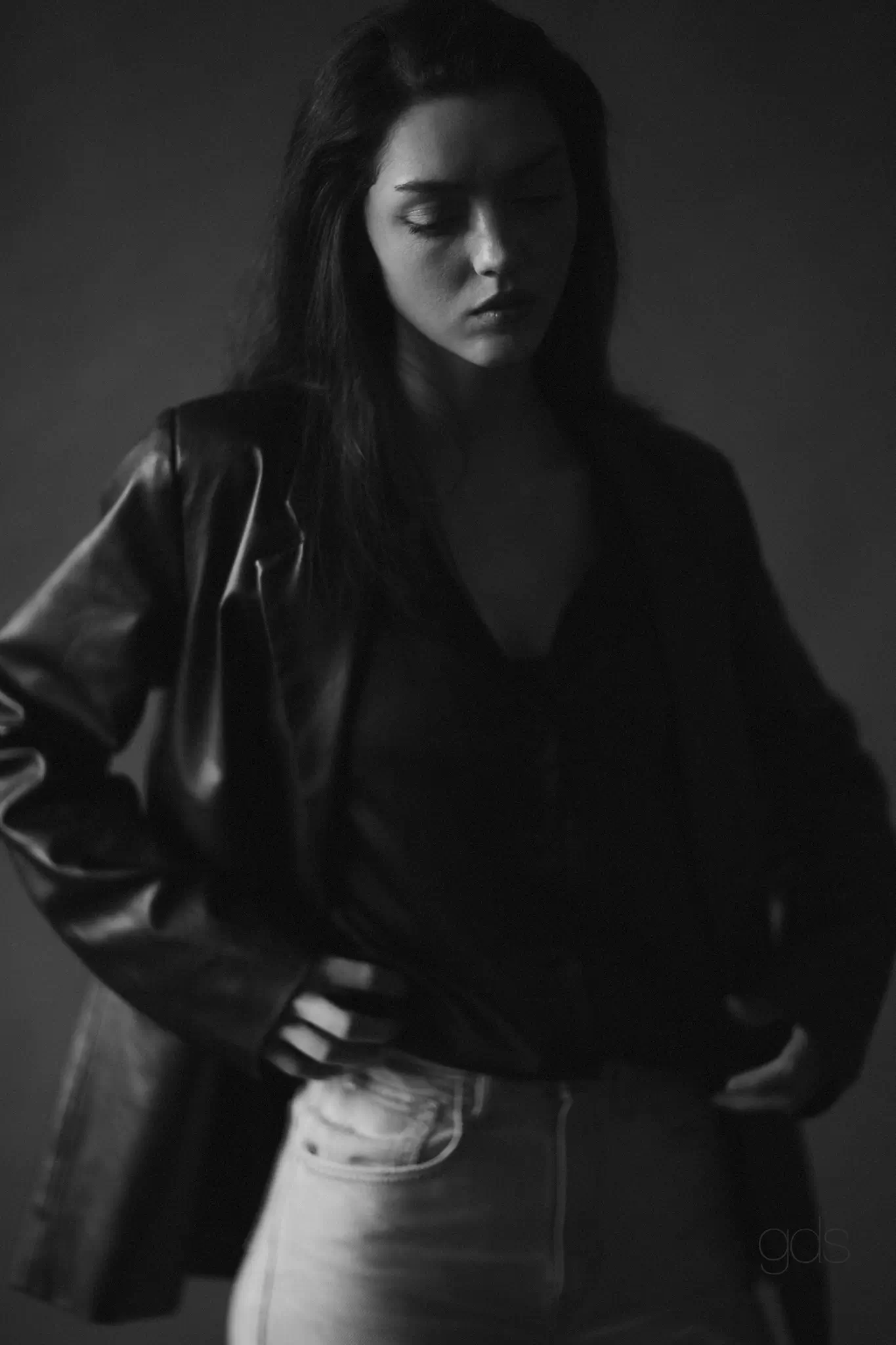
This image is from a recent shoot. I chose it because it represents the look and style I am currently focusing on, embracing all the elements I mentioned.
Shot in an empty warehouse, the location features a large window that lets in just the right amount of natural light. At the time of day I hire the space, the light is always soft, and I position the model and backdrop to get just the right falloff and shadow on the model’s face.
I use a newer mirrorless Canon R5, but I have adapted an older EF 85mm f/1.2 lens to it, shooting wide open at f/1.2. I know the lens is good, but it isn’t at its absolute sharpest at 1.2, and that is intentional. I want the imperfections; I want it to sometimes slightly miss focus. This image captures almost all of that. As a portrait and a final image, my goal is to create mood. Perfection often strips away emotion, whereas controlled chaos will always surprise you and exceed expectations. Aside from some added grain, there is very little post-processing involved.
This portrait is wonderful. The pose, the feeling, the mood. And one thing I also consider fundamental in my own work: imperfections. Which doesn’t mean errors. It means to me to let every image be true.
Imperfections are what make an image look perfect to my eyes.
Here below the links where you can enjoy more of Giuseppe’s work. And you will enjoy it, I’m pretty sure about it:
Thanks for being here and for sharing this wonderful image, Giuseppe.
Take care and talk soon!