
Questo articolo è disponibile anche in Italiano
Happy Tuesday my friend! Welcome back to another appointment with My Travel Diary Chronicles. This series, you know by now, it’s created in collaboration with Tamara, who provides the story and the images. And I love it because she’s an excellent writer and because it offers a glimpse into her amazing travel adventures.
After the long journey throughout Laos described in the previous articles, it’s time for a quick trip to Italy, our home, to discover a gem in the heart of Tuscany.
Another place full of history and faith.
Enjoy!
Beneath the motorcycle’s wheels, the road runs and Tuscany, all around me, seems to have no sense of urgency.
The hills unfold in gentle succession, shaped by dark woods and mosaics of cultivated fields that the sun illuminates in patches. Tender green meadows mingle with the ochre of the earth and the first brushstrokes of golden wheat.
Behind a ridge, the asphalt disappears, then reappears farther on, like a line of ink. Beyond the broom, fields suddenly open, cypress trees mark the horizon, and wooded patches gather in the folds of the hills.
Every bend takes something away from urgency and gives space back to the gaze.
Then a monumental structure emerges from the expanse of tall grasses, rippling in the breeze.
The Basilica of San Galgano.
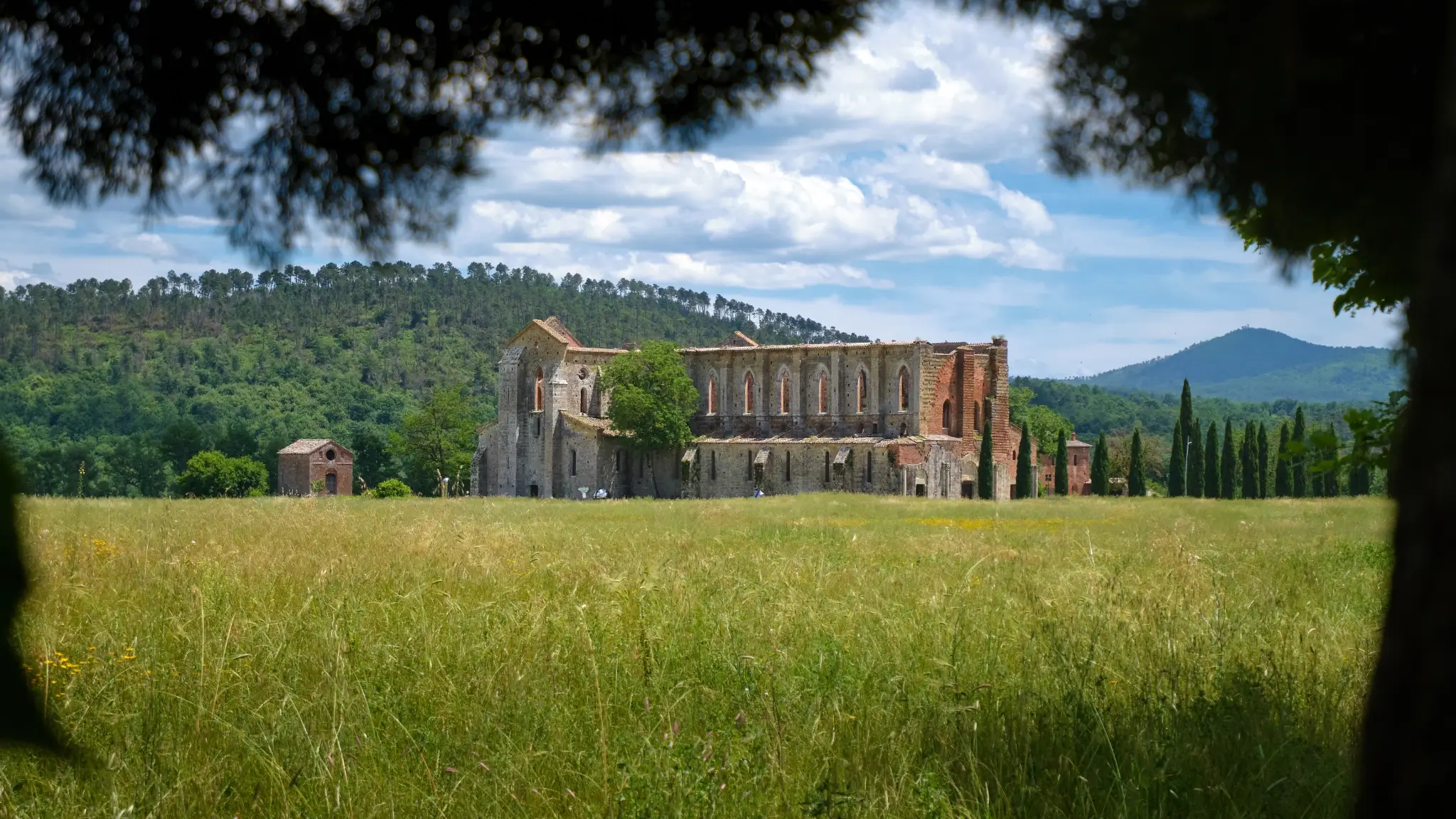
I draw closer.
The first thing I notice is what is not there.
The roof.
Here, the sky has entered the church.
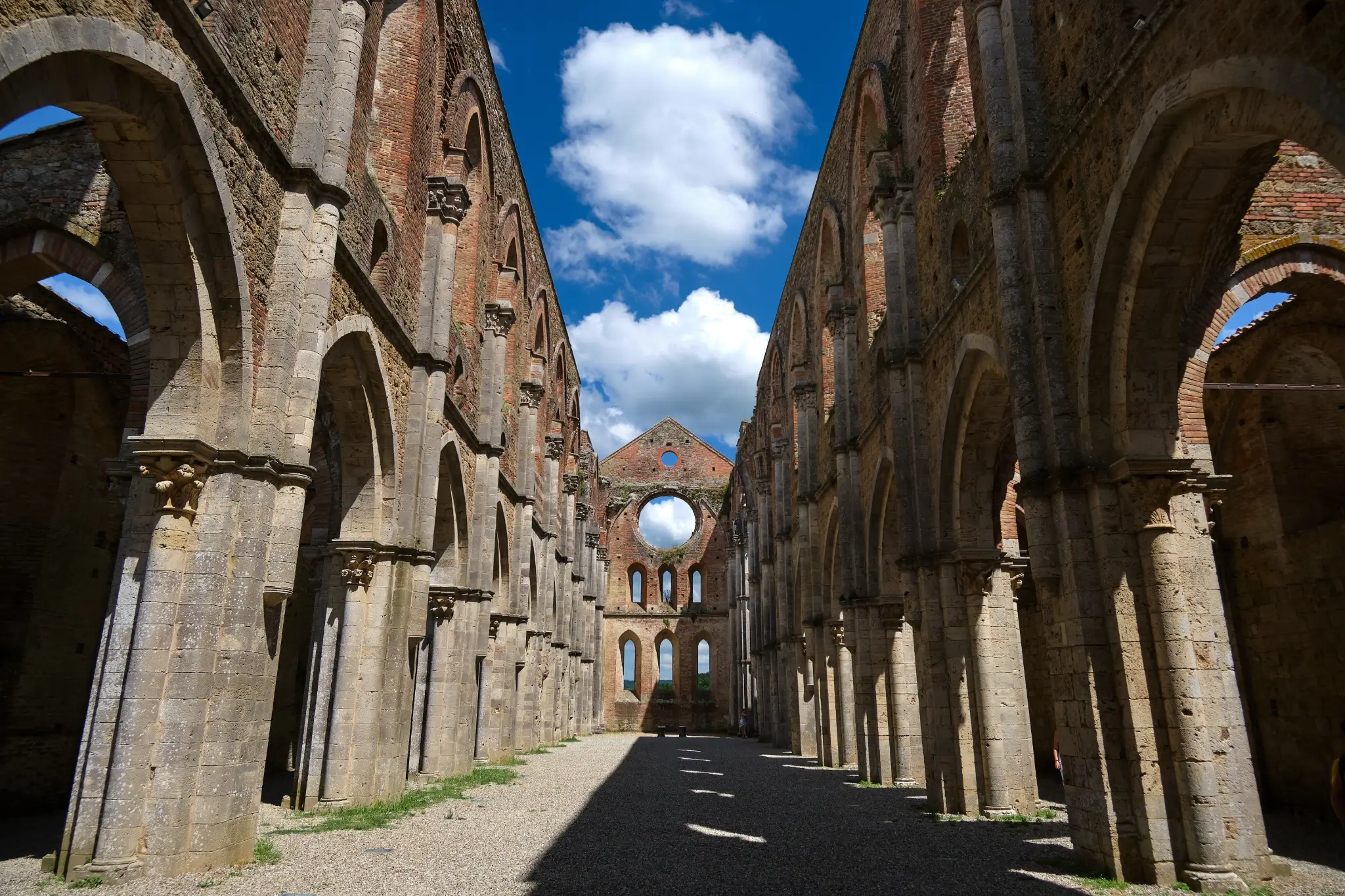
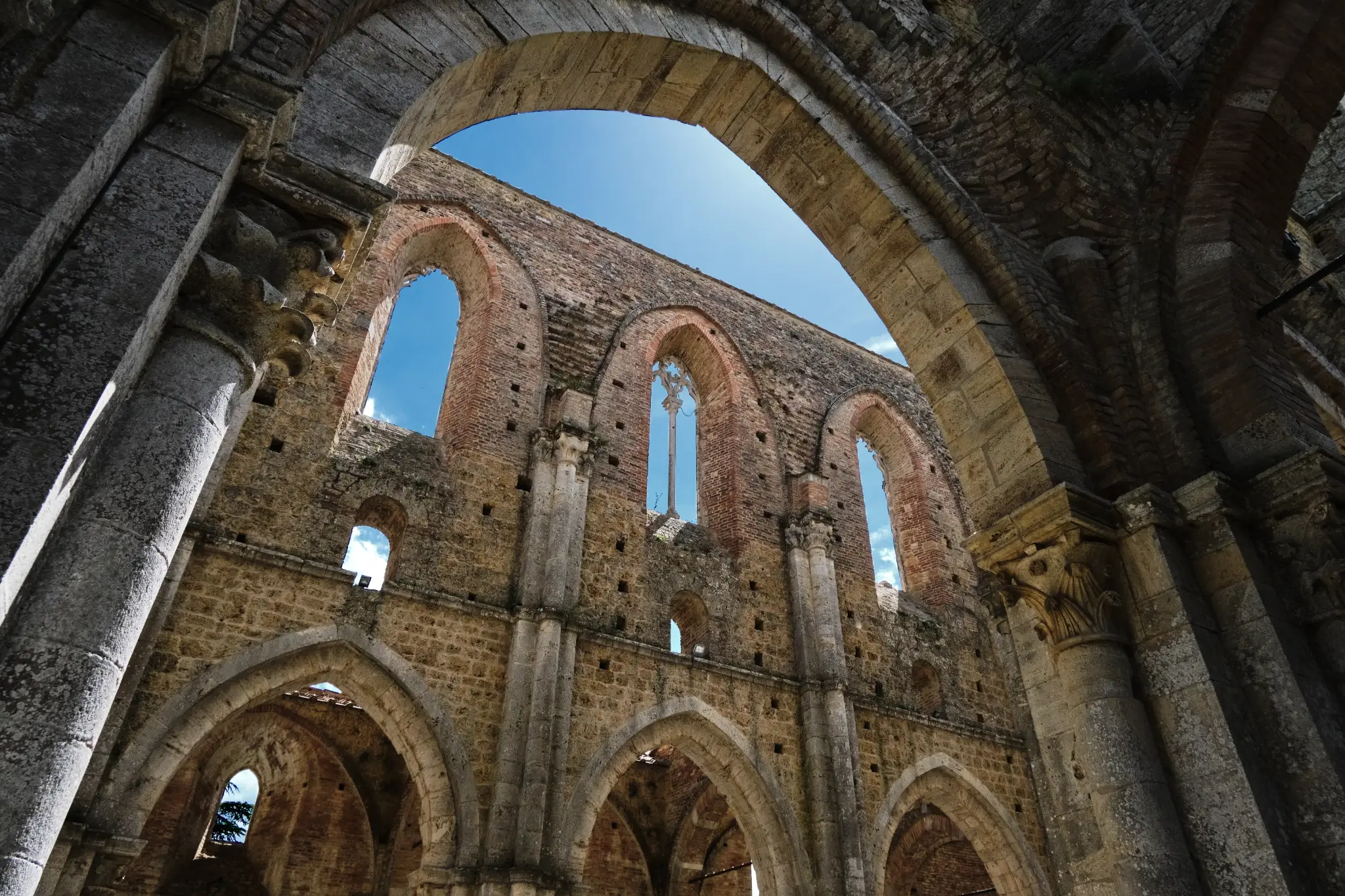
Light falls directly onto the naves and slips along the massive pillars; almost in reverse, my eyes climb the profile of the pointed arches until I lose myself where the ribbed vaults once sprang.
Air moves through the empty spaces, carrying with it the scents of the countryside. Tufts of grass grow where monks and pilgrims walked for centuries.
The severe Cistercian geometry survives in the succession of the bays, in the more than one hundred capitals with phytomorphic motifs that have allowed the seasons to gnaw at them. The splayed lancet windows still punctuate the rhythm of the perimeter walls; in the transept, a bare oculus preserves only the trace of a lost rose window.
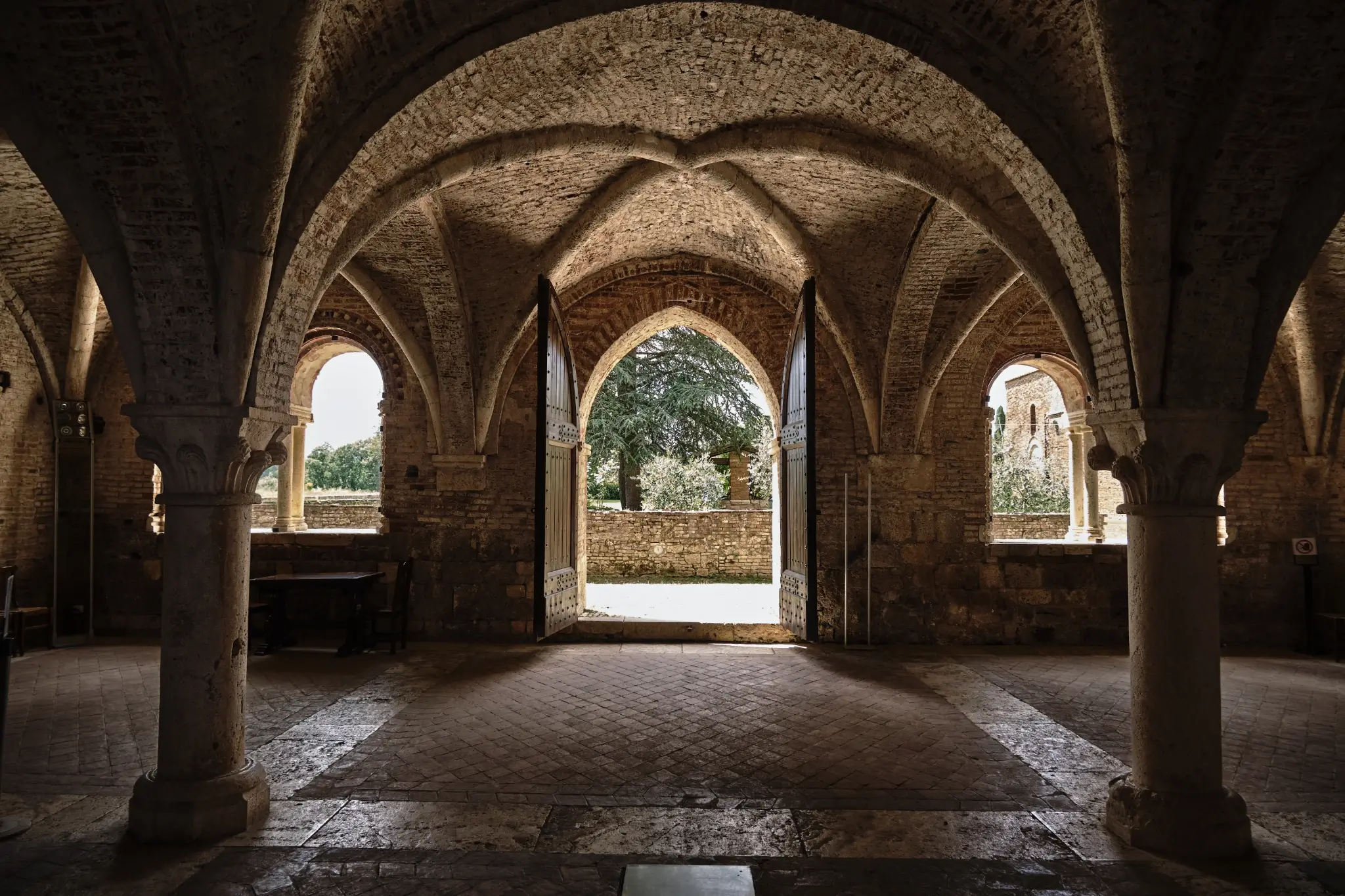
I remain silent.
I cannot simply call it a ruin. There is something in these roofless walls that does not belong to an ending.
Perhaps because, from the very beginning, its story has been one of transformation: a knight who lays down his former life to become a hermit, a sword that ceases to be a weapon and becomes a cross.
A solitary hilltop that, within a few decades, becomes the centre of a community capable of concentrating property, wealth and power.
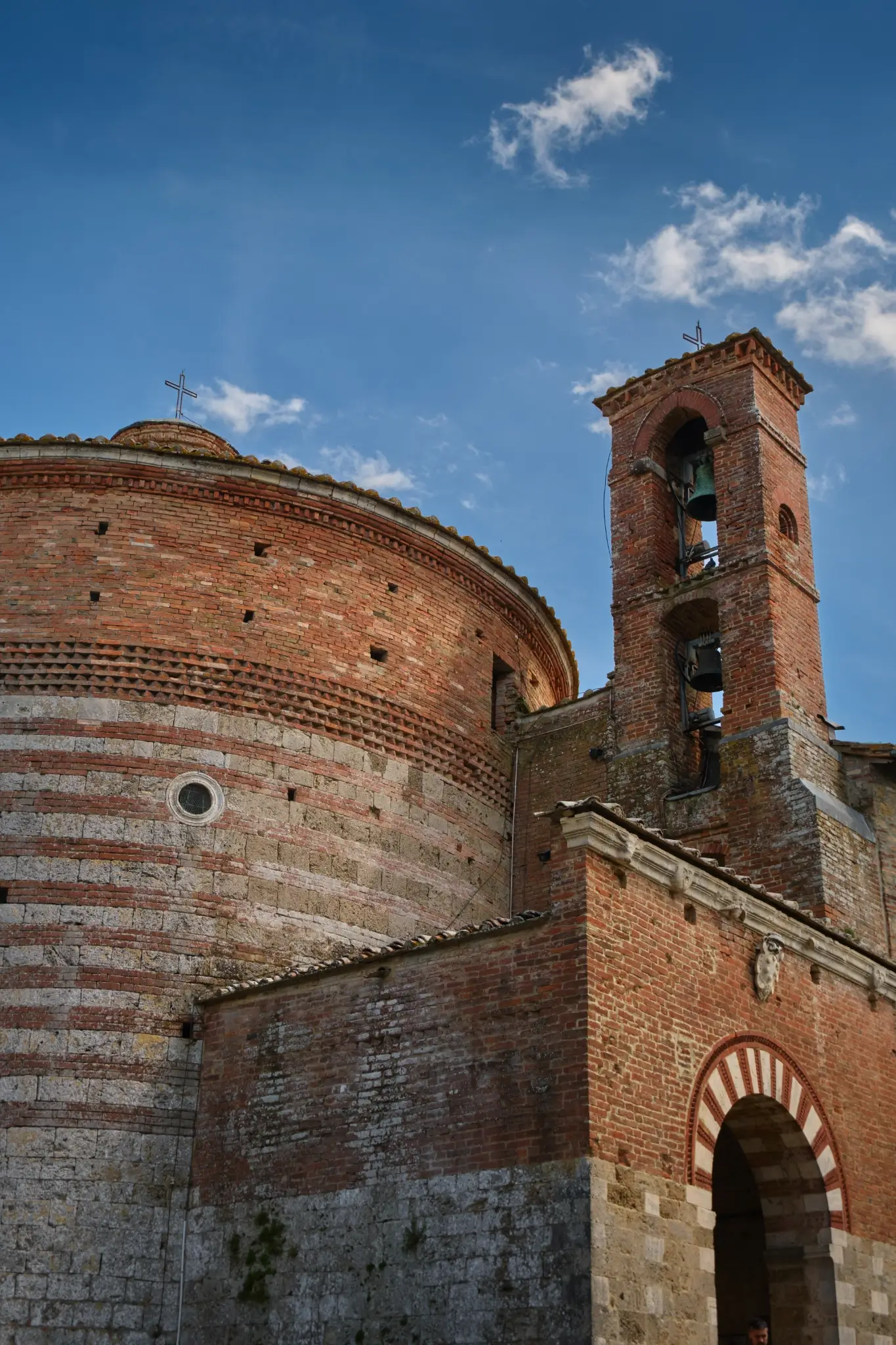
To understand all this, I have to climb to Montesiepi.
This is where Galgano Guidotti changes direction.
The hagiographies of his youth offer an image far removed from that of the hermit he would become: a fourteenth-century Vita in the vernacular describes him as a «huomo feroce e lascivo», immersed in passions and worldly affairs.1 Galgano was a man of arms, belonging to a world in which strength, courage and the ability to fight were regarded as essential virtues.
Then something breaks.
The oldest document is the Inquisitio in partibus of 1185. Four years after his death, three papal delegates climb to Montesiepi to collect the testimonies of those who had known him and were already calling him a saint. Among them is Dionisia, his mother.2
She is the one who recounts her son’s mystical experiences.
The young man is said to have told her that he had seen the archangel Michael, who asked that Galgano be entrusted to him so that he might make him a soldier.
A few years later, Michael appears again, and this time he comes to call Galgano himself.
Sequere me.
Follow me.
Galgano sets out. He crosses a river, passes over a difficult bridge and reaches a flower-filled meadow, steeped in fragrance. Here he encounters the apostles, who show him a round house and reveal the place where he is to remain.3
For a moment, the story seems to leave those ancient pages and take shape before me. Still, the hill is there. Streams follow the same slopes, the brightness slips across the earth as though eight centuries were nothing more than a thin veil spread over the landscape.
Now the vision guides him towards the place indicated. But at a certain point the horse stops and refuses to go any farther.
Galgano lets go of the reins and entrusts himself to the direction chosen by the animal.
This is how he reaches Montesiepi.
And on this hilltop he lays aside the clothes of the knight and chooses a life of prayer and penance.4
He searches for a sign to which he can entrust his faith and tries to build a cross but, unable to do so, draws his sword and drives it into the ground.
Legend tells that the weapon became fused with the stone through divine intervention, so that no one could ever draw it out again.5
It still stands at the centre of the hermitage, protected by a glass case. Together, the vertical blade and the crosswise hilt form a cruciform figure.
Thus, the symbol comes to transcend the story itself.
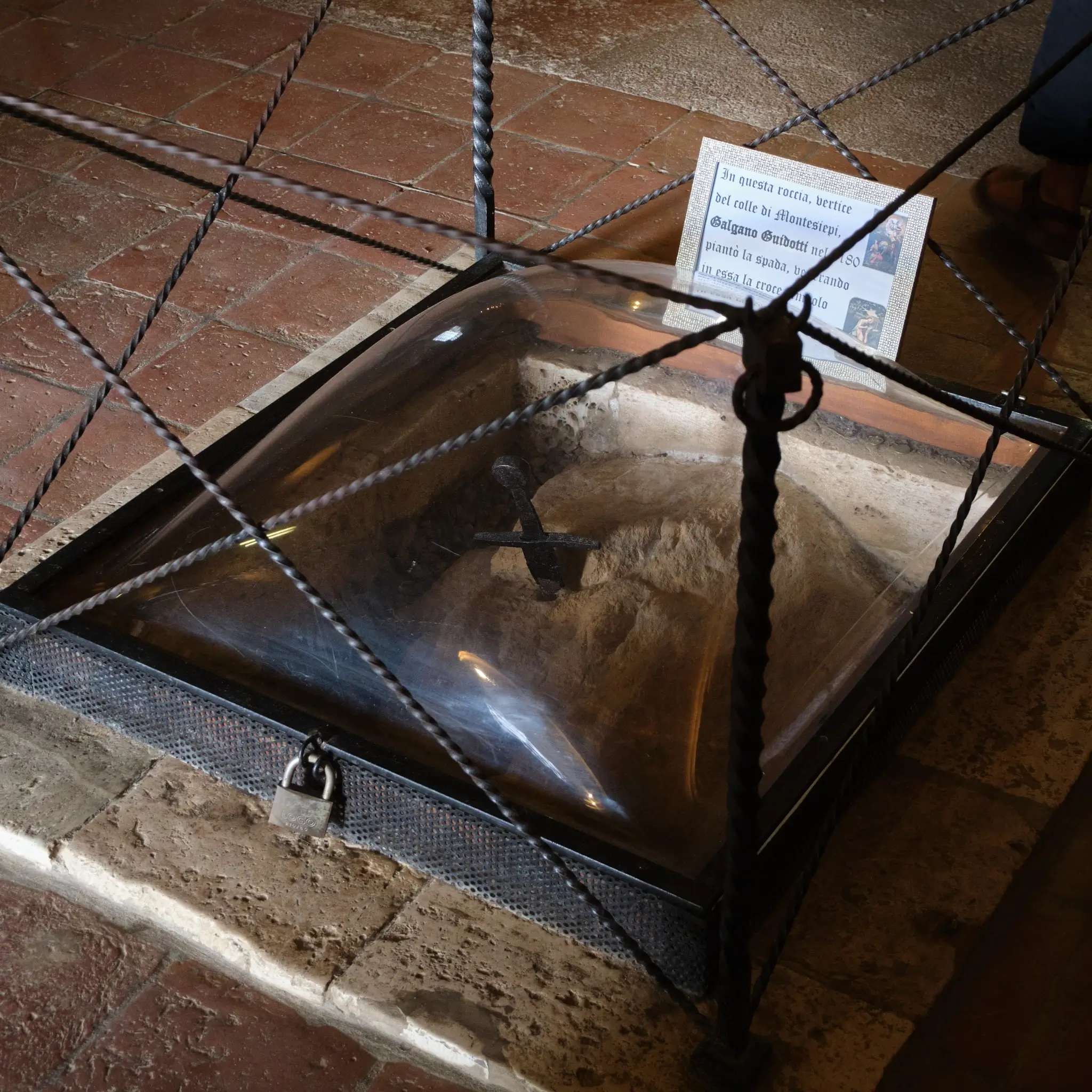
The sword is not destroyed.
It is transformed.
What once belonged to war is removed from combat. The gesture does not erase the knight he had been: it overturns him, giving him a new meaning.
The brief experience of the hermit’s life ends in 1181.6
But his death is only the beginning of another story.
Around his memory, the first followers gather, and soon the small dwelling is no longer enough. Thus, in 1218, work begins on a great abbey.7
The complex grows, and with it its domain.
Possessions multiply, estates expand, granges, mills, fulling mills and ironworks appear. Monks clear the land, exploit the forests and channel the waters of the Merse. Across the valley, a network of work and exchange takes shape, where resources and activities are woven together.8
The Cistercians reshape the landscape.
By the middle of the thirteenth century, San Galgano has become an economic and political power whose influence reaches as far as Siena.
In 1257, the monk Ugo becomes camerlengo of the Biccherna, the office responsible for administering its finances.9 Other monks from the abbey would later hold the same position.10
The city also turns to their expertise: from the study of the aqueduct intended to carry water from the Val di Merse to the works of the cathedral.11
Its solitude has become a community.
The community, a power.
And power, a part of Siena’s history.
Galgano’s cell is now far away.
In its place stands a centre destined to influence the fortunes of the Republic itself.
It is a difficult parabola to imagine as I walk in the quiet of Montesiepi. What began as an escape from the world ended up transforming it.
Then the rise comes to an end.
In the fourteenth century, the famine of 1328 and, twenty years later, the plague began to erode the abbey’s prosperity. Wars and economic difficulties slowly drained its resources. Revenues dwindled, the number of monks declined and the balance built over generations began to unravel.12
In the fifteenth century, the decline accelerates. Abandonment creeps into the monastery’s rooms, and commendatory abbots, distant from the daily life of the religious community, accompany its slow dissolution.13
The first cracks become collapses. In 1781, the surviving vaults gave way. In 1786, lightning brought down the bell tower. Three years later, the church was deconsecrated.14
What generations had raised now falls.
The roof disappears.
And time enters the church.
A skeleton of stone survives, more tenacious than the flesh that once clothed it. The ribs trace the geometry of the lost roof in the air; the three naves now open towards the blue.15
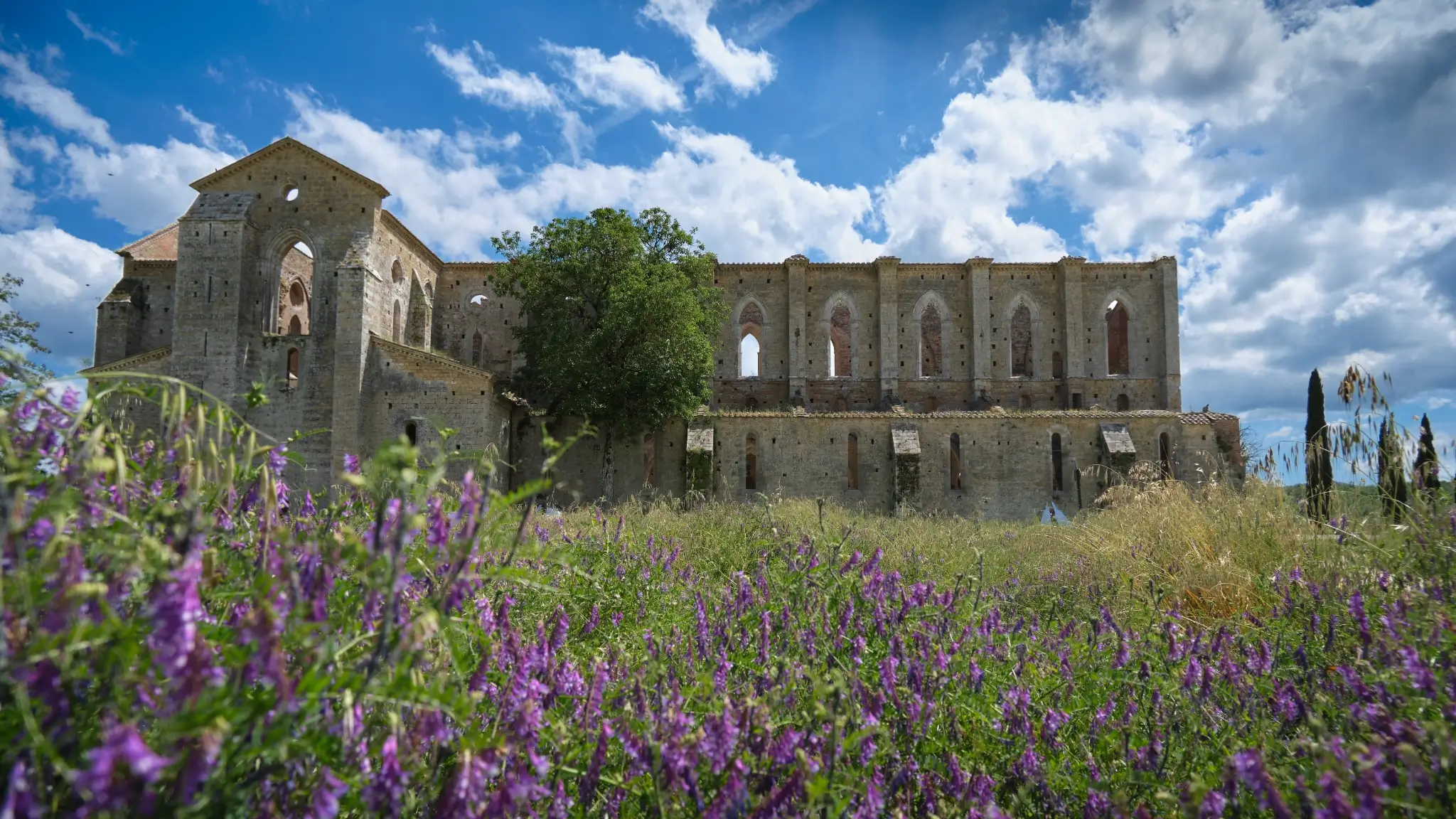
I get back on the motorcycle, watching San Galgano in the rear-view mirror. It remains there, bearing witness to the fact that time does not truly erase things. It strips them, changes them, transforms them.
Here, it has consumed the material and allowed what remains to emerge.
It has made absence into a beauty no architect ever intended.
Today it has no roof.
It has gained the entire sky.
Take care and talk soon!
Versione Italiana
La strada corre sotto le ruote della moto e la Toscana, intorno, sembra non avere fretta.
Le colline si susseguono morbide, disegnate da boschi scuri e mosaici di coltivi che il sole accende a tratti. Il verde tenero dei prati si mescola all’ocra della terra e alle prime pennellate d’oro del grano.
L’asfalto scompare dietro un crinale e poi ricompare più avanti, come una linea d’inchiostro. I campi si aprono improvvisamente oltre le ginestre, i cipressi segnano l’orizzonte, le macchie arboree si addensano nelle pieghe dei dossi.
Ogni curva sottrae qualcosa all’urgenza e restituisce spazio allo sguardo.
Poi, una costruzione monumentale affiora dalla distesa delle alte graminacee, increspate dalla brezza.
La basilica di San Galgano.
Mi avvicino.
La prima cosa che noto è ciò che non c’è.
Il tetto.
Qui il cielo è entrato dentro la chiesa.
La luce scende direttamente sulle navate e scivola lungo i possenti pilastri; quasi a ritroso, risalgo con gli occhi il profilo degli archi a sesto acuto, fino a perdermi là dove un tempo si impostavano le volte a crociera.
L’aria attraversa gli spazi vuoti, portando con sé gli odori della campagna. Ciuffi d’erba crescono là dove per secoli hanno camminato monaci e pellegrini.
La severa geometria cistercense sopravvive nella successione delle campate, nei più di cento capitelli dai motivi fitomorfi che si sono lasciati mordere dalle stagioni. Le monofore strombate scandiscono ancora il ritmo dei muri perimetrali; nel transetto, un oculo spoglio conserva solo la traccia di un rosone perduto.
Rimango in silenzio.
Non riesco a chiamarla semplicemente una rovina. C’è qualcosa, in queste mura scoperchiate, che non appartiene alla fine.
Forse perché, fin dall’inizio, la sua storia parla di metamorfosi: un cavaliere che depone la propria esistenza per farsi eremita, una spada che smette di essere arma e diventa croce.
Un poggio solitario che, in pochi decenni, si fa polo di una comunità capace di concentrare proprietà, ricchezze e potere.
Per capire tutto questo bisogna salire a Montesiepi.
È qui che Galgano Guidotti cambia direzione.
Le agiografie sulla sua giovinezza restituiscono un’immagine lontanissima da quella dell’anacoreta che sarebbe diventato: una Vita in volgare del Trecento lo definisce «huomo feroce e lascivo», immerso nelle passioni e nelle cose terrene. Galgano era un uomo d’arme e apparteneva a un mondo nel quale la forza, il coraggio e la capacità di combattere erano considerate virtù essenziali.16
Poi qualcosa si spezza.
Il documento più antico è l’Inquisitio in partibus del 1185. Quattro anni dopo la sua morte tre delegati papali salgono a Montesiepi per raccogliere le deposizioni di chi lo aveva conosciuto e già lo diceva santo. Tra queste, quella di Dionisia, sua madre.17
È lei a raccontare le esperienze mistiche del figlio.
Il giovane le avrebbe riferito di aver visto l’arcangelo Michele, che chiedeva di affidarglielo perché ne facesse un soldato.
Qualche anno dopo, Michele torna a manifestarsi e questa volta viene a chiamare proprio lui.
Sequere me.
Seguimi.
Galgano parte. Supera un fiume, passa su un ponte difficile e giunge in un prato fiorito, pervaso di profumi. Qui incontra gli apostoli, che gli mostrano una casa rotonda e gli rivelano il posto dove dovrà fermarsi.18
Per un istante, il racconto sembra uscire da quelle pagine antiche e prendere corpo davanti a me. L’altura è ancora lì. I torrenti seguono gli stessi pendii, il chiarore scivola sulle zolle come se otto secoli fossero soltanto un velo sottile steso sopra il paesaggio.
La visione lo conduce ora verso il luogo indicato. Ma il cavallo, a un certo punto, si arresta e non vuole più proseguire.
Galgano lascia le briglie e si affida alla direzione scelta dall’animale.
È così che raggiunge Montesiepi.
E su questa altura depone gli abiti del cavaliere e sceglie una vita di preghiera e penitenza.19
Cerca un segno a cui affidare la propria fede e prova a costruire una croce ma, non riuscendoci, sguaina la spada e la conficca nel terreno.
La leggenda racconta che l’arma si sarebbe saldata alla pietra per virtù divina, tanto che nessuno sarebbe più riuscito a estrarla.20
Resiste ancora, al centro dell’eremo, protetta da una teca. La lama verticale e l’elsa disposta trasversalmente compongono una figura cruciforme.
Il simbolo finisce così per superare la vicenda stessa.
La spada non viene distrutta.
Viene trasformata.
Ciò che apparteneva alla guerra viene sottratto al combattimento. Il gesto non cancella il cavaliere che era stato: lo rovescia, gli dà un significato nuovo.
La breve esperienza eremitica si conclude nel 1181.21
Ma la sua morte è soltanto l’inizio di un’altra storia.
Intorno alla sua memoria si raccolgono i primi seguaci e ben presto la piccola dimora non basta più. Così nel 1218 iniziano i lavori di una grande abbazia.22
Il complesso cresce e con esso il suo dominio.
Si moltiplicano i possedimenti, si estendono le proprietà, sorgono grange, mulini, gualchiere e ferriere. I monaci dissodano le terre, sfruttano i boschi, incanalano le acque della Merse. La valle diventa una trama di lavoro e di scambi, dove risorse e attività entrano in relazione.23
I Cistercensi ridisegnano il territorio.
A metà del Duecento San Galgano è ormai una potenza economica e politica, la cui influenza arriva fino a Siena.24
Nel 1257 il monaco Ugo diventa camerlengo della Biccherna, l’ufficio incaricato di amministrarne le finanze. Altri religiosi dell’abbazia ricopriranno in seguito lo stesso incarico.25
Anche la città ricorre alle loro competenze: dallo studio dell’acquedotto destinato a portare l’acqua della Val di Merse ai lavori della cattedrale.26
La sua solitudine è diventata una comunità.
La comunità, un potere.
E il potere, una parte della storia di Siena.
La cella di Galgano è ormai lontanissima.
Al suo posto sorge un centro destinato a pesare sulle sorti della Repubblica stessa.
È una parabola difficile da immaginare mentre cammino nel raccoglimento di Montesiepi. Quella che era nata come una fuga dal mondo è finita per trasformarlo.
Poi l’ascesa si interrompe.
Nel XIV secolo la carestia del 1328 e, vent’anni più tardi, la peste cominciano a scavare nella prosperità dell’abbazia. Le guerre e le difficoltà economiche ne erodono lentamente le risorse. Le rendite si assottigliano, i religiosi diminuiscono e l’equilibrio costruito per generazioni comincia a sfaldarsi.27
Nel Quattrocento il declino accelera. L’abbandono si insinua negli ambienti del monastero e gli abati commendatari, lontani dalla quotidianità dei religiosi, ne accompagnano la lenta dissoluzione.28
Le prime crepe si fanno cedimenti. Nel 1781 crollano le volte superstiti. Nel 1786 un fulmine abbatte il campanile. Tre anni dopo, la chiesa viene sconsacrata.29
Quello che per generazioni si era innalzato ora precipita.
Il tetto scompare.
E il tempo entra dentro la chiesa.
Sopravvive uno scheletro di roccia, più tenace della carne che un giorno lo rivestiva. I costoloni tracciano nell’aria la geometria della copertura perduta; le tre navate si aprono ormai verso l’azzurro.30
Risalgo in moto mentre guardo nello specchietto retrovisore. San Galgano resta lì a testimoniare che il tempo non cancella davvero le cose. Le spoglia, le muta, le trasfigura.
Qui ha consumato la materia e lasciato emergere ciò che resta.
Ha fatto dell’assenza una bellezza che nessun architetto aveva previsto.
Oggi non ha più un tetto.
Ha guadagnato l’intero cielo.
- Roberta Mucciarelli, “GALGANO, santo”, in Dizionario Biografico degli Italiani, vol. 51, Rome, Istituto dell’Enciclopedia Italiana, 1998. The entry examines the traditions concerning Galgano’s youth and the earliest sources relating to his life.
Treccani — Galgano, saint ↩︎ - Eugenio Susi, De vita et actibus Galgani… L’Inquisitio in partibus…, in Analecta Galganiana, Siena, Nuova Immagine Editrice, 2021, pp. 9–91; Fedor Schneider, “Der Einsiedler Galgan von Chiusdino und die Anfänge von S. Galgano”, Quellen und Forschungen aus italienischen Archiven und Bibliotheken, XVII, 1914–1924, pp. 71–77. The Inquisitio in partibus of 1185 is the oldest documentary source concerning Galgano and contains the testimony of Dionisia, his mother.
Treccani — Galgano, saint ↩︎ - Eugenio Susi, De vita et actibus Galgani… L’Inquisitio in partibus…, cit. The testimony records the visions of the archangel Michael, the command Sequere me, Galgano’s journey and the appearance of the apostles.
Treccani — Galgano, saint ↩︎ - Roberta Mucciarelli, “GALGANO, santo”, cit. The sources place Galgano’s hermitage and his choice of an ascetic life at Montesiepi.
Treccani — Galgano, saint ↩︎ - Anna Benvenuti (ed.), La spada nella roccia. San Galgano e l’epopea eremitica di Montesiepi, Florence, Mandragora, 2004. The earliest traditions describe Galgano planting his sword in the ground in the form of a cross; the familiar image of the “sword in the stone” belongs to a later development of the legend. ↩︎
- Roberta Mucciarelli, “GALGANO, santo”, cit. Galgano is traditionally considered to have died on 30 November 1181 at Montesiepi.
Treccani — Galgano, saint ↩︎ - Fondazione San Galgano, “The Cistercian Abbey of San Galgano”. The administrative records known as the caleffiattest to the construction of the abbey complex beginning in 1218 and continuing through the thirteenth century.
Fondazione San Galgano — The Cistercian Abbey ↩︎ - Andrea Barlucchi, “Il patrimonio fondiario dell’abbazia di San Galgano (secc. XIII-inizi XIV). Prima parte: consistenza e formazione”, Rivista di Storia dell’Agricoltura, XXXI, no. 2, December 1991, pp. 63–108; and “Seconda parte: la gestione”, XXXII, no. 1, June 1992, pp. 55–80. See also Maria Elena Cortese, L’acqua, il grano, il ferro. Opifici idraulici medievali nel bacino Farma-Merse, Florence, All’Insegna del Giglio, 1997, pp. 100–114. These studies document the abbey’s extensive landed possessions and its productive activities, including mills and ironworking installations. ↩︎
- Andrea Barlucchi, Il patrimonio fondiario dell’abbazia di San Galgano, cit.; Archivio di Stato di Siena, Museo delle Biccherne. The records document the role played by monks of San Galgano in the administration of Siena’s finances and the abbey’s growing political and economic importance. ↩︎
- Archivio di Stato di Siena, Museo delle Biccherne; Sistema Archivistico Nazionale, Tavole di Biccherna. Archivio di Stato di Siena (1258–1713). Don Ugo, a monk of San Galgano, is documented as camerlengo of the Biccherna; the collection also preserves the panel dedicated to him. The archival inventory identifies the first Biccherna panel as dating from the second half of 1258 and names it “Don Ugo, monk of San Galgano.”
Archivio di Stato di Siena — Museo delle Biccherne
Archivio di Stato di Siena — Biccherna Inventory ↩︎ - Antonio Canestrelli, L’abbazia di San Galgano: monografia storico-artistica con documenti inediti e numerose illustrazioni, Florence, Fratelli Alinari, 1896. The work documents the relationship between the abbey and the city of Siena, including the involvement of its religious community in major civic and architectural projects. ↩︎
- IVIPRO, “Abbazia di San Galgano – Cenni storici”. The abbey’s crisis in the fourteenth century was aggravated first by the famine of 1328 and then by the plague of 1348; in the second half of the century, repeated attacks and looting by mercenary companies further weakened the community and its resources.
IVIPRO — Abbey of San Galgano, historical notes ↩︎ - Consiglio Regionale della Toscana, San Galgano; IVIPRO, “Abbazia di San Galgano – Cenni storici”. The fifteenth century marked an accelerating decline, followed by the progressive abandonment of the monastic complex and the transfer of the abbey into commendatory administration.
Consiglio Regionale della Toscana — San Galgano
IVIPRO — Abbey of San Galgano, historical notes ↩︎ - Comune di Chiusdino, “Abbazia di San Galgano”. The abbey’s decline culminated in 1781 with the collapse of the church vaults, in 1786 with the destruction of the bell tower, and in 1789 with the ecclesiastical sentence of profanation.
Comune di Chiusdino — Abbey of San Galgano ↩︎ - Fondazione San Galgano, “The Cistercian Abbey of San Galgano”. The church has a Latin-cross plan, three naves and sixteen cruciform pillars; the surviving structure today remains open to the sky following the loss of its vaults and roof.
Fondazione San Galgano — The Cistercian Abbey ↩︎ - Roberta Mucciarelli, “GALGANO, santo”, in Dizionario Biografico degli Italiani, vol. 51, Roma, Istituto dell’Enciclopedia Italiana, 1998. La voce ricostruisce la tradizione agiografica sulla giovinezza di Galgano e le prime fonti sulla sua vita.
Treccani — GALGANO, santo ↩︎ - Eugenio Susi, De vita et actibus Galgani et miraculis ab eodem ante obitum et post obitum divino nutu factis. L’Inquisitio in partibus su san Galgano da Chiusdino, in Analecta Galganiana, Siena, Nuova Immagine Editrice, 2021, pp. 9-91; Fedor Schneider, “Der Einsiedler Galgan von Chiusdino und die Anfänge von S. Galgano”, in Quellen und Forschungen aus italienischen Archiven und Bibliotheken, XVII, 1914-1924, pp. 71-77. La Inquisitio in partibus del 1185 è la più antica fonte della vita di Galgano e comprende la deposizione della madre Dionisia.
Treccani — fonte sulla Inquisitio del 1185 ↩︎ - Eugenio Susi, L’Inquisitio in partibus su san Galgano da Chiusdino, cit. Le visioni dell’arcangelo Michele, il comando Sequere me, il viaggio verso Montesiepi e l’incontro con gli apostoli appartengono alla tradizione dell’Inquisitio.
Treccani — GALGANO, santo ↩︎ - Roberta Mucciarelli, “GALGANO, santo”, cit. La fonte ricostruisce la scelta di Montesiepi e la successiva esperienza eremitica di Galgano.
Treccani — GALGANO, santo ↩︎ - Anna Benvenuti (a cura di), La spada nella roccia. San Galgano e l’epopea eremitica di Montesiepi, Firenze, Mandragora, 2004. La documentazione più antica descrive la spada conficcata nel terreno a forma di croce; la tradizione della “spada nella roccia” appartiene alla successiva elaborazione agiografica e iconografica. ↩︎
- Roberta Mucciarelli, “GALGANO, santo”, cit. Galgano morì con ogni probabilità il 30 novembre 1181 a Montesiepi.
Treccani — GALGANO, santo ↩︎ - Fondazione San Galgano, L’Abbazia Cistercense di San Galgano. I caleffi dell’Archivio di Stato di Siena attestano il cantiere di costruzione dell’abbazia dal 1218 al 1288.
Fondazione San Galgano — L’Abbazia Cistercense ↩︎ - Andrea Barlucchi, “Il patrimonio fondiario dell’abbazia di San Galgano (secc. XIII-inizi XIV). Prima parte: consistenza e formazione”, Rivista di Storia dell’Agricoltura, XXXI, n. 2, 1991, pp. 63-108; Id., “Il patrimonio fondiario dell’abbazia di San Galgano (secc. XIII-inizi XIV). Parte II. La gestione”, Rivista di Storia dell’Agricoltura, XXXII, n. 1, 1992, pp. 55-80; Maria Elena Cortese, L’acqua, il grano, il ferro. Opifici idraulici medievali nel bacino Farma-Merse, Firenze, All’Insegna del Giglio, 1997, pp. 100-114. ↩︎
- Andrea Barlucchi, Il patrimonio fondiario dell’abbazia di San Galgano, cit. Per il ruolo dei monaci di San Galgano nella vita economica e politica senese è utile anche la documentazione istituzionale sulla Biccherna e la sintesi di Visit Tuscany.
Archivio di Stato di Siena — Museo delle Biccherne
Visit Tuscany — Abbazia di San Galgano ↩︎ - Archivio di Stato di Siena, Museo delle Biccherne; Sistema Archivistico Nazionale, Tavole di Biccherna. Archivio di Stato di Siena (1258-1713). Don Ugo, monaco di San Galgano, è documentato come camarlengo della Biccherna; la collezione conserva inoltre la tavoletta a lui dedicata.
Sistema Archivistico Nazionale — Tavole di Biccherna
Archivio di Stato di Siena — Museo delle Biccherne ↩︎ - Antonio Canestrelli, L’abbazia di San Galgano: monografia storico-artistica con documenti inediti e numerose illustrazioni, Firenze, Fratelli Alinari, 1896. Per i rapporti fra San Galgano e Siena, compreso il ruolo dei religiosi nell’amministrazione cittadina e nell’Opera del Duomo, si veda anche la documentazione storica raccolta nella monografia ↩︎
- La crisi dell’abbazia nel XIV secolo fu aggravata dalla carestia del 1328 e dalla peste del 1348; nella seconda metà del secolo si aggiunsero i saccheggi delle compagnie di ventura. Alla fine del secolo la comunità monastica si era ridotta a otto persone.
IVIPRO — Abbazia di San Galgano, cenni storici ↩︎ - Il declino proseguì nel Quattrocento: nel 1474 i monaci abbandonarono il monastero trasferendosi a Siena. Nel 1503 Giulio II destinò l’abbazia in commenda al cardinale Federico Sanseveroni.
Consiglio regionale della Toscana — San Galgano
IVIPRO — Abbazia di San Galgano, cenni storici ↩︎ - Nel 1781 crollarono le parti superstiti della copertura; nel 1786 un fulmine abbatté il campanile. Nel 1789 la chiesa fu interessata dalla sentenza ecclesiastica di profanazione.
Consiglio regionale della Toscana — San Galgano
Comune di Chiusdino — Abbazia di San Galgano ↩︎ - La basilica presenta pianta a croce latina e tre navate divise da 16 pilastri cruciformi, secondo l’impianto delle grandi abbazie cistercensi.
Fondazione San Galgano — L’Abbazia Cistercense ↩︎